At Malt, we have a front-row seat to the technological shifts happening every day—and we know better than anyone that in AI, 'fast' is an understatement. AI has evolved from a gadget for experimentation into a critical business infrastructure. Freelancers are naturally at the forefront of this shift. While others are still stuck in training rooms, they are already building the next generation of industrial execution. We don't need to 'teach' our community how to lead; they are already on the front lines. Our mission is simply to bridge the gap between their native expertise and the companies that can no longer afford to wait.
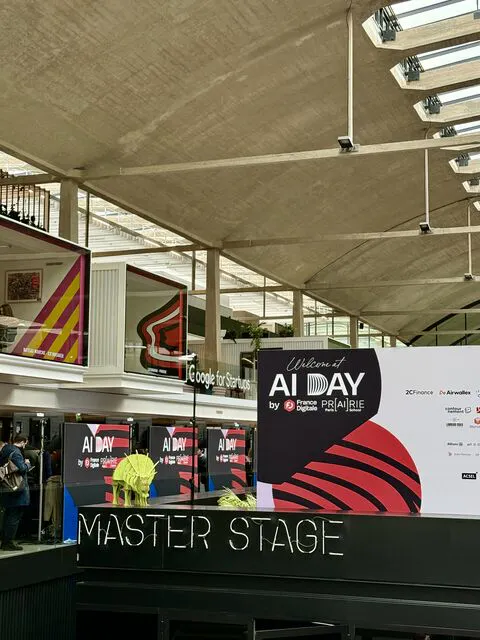
Attending AI Day 2026 at Station F in February confirmed this vision. One question was on everyone's lips: "Are we in an AI bubble?" The debates were intense: will it grow, stabilize, or eventually pop? But as I listened to the speakers, a more interesting reality emerged. For the builders, the AI freelancers experts I meet every day at Malt, this isn’t a bubble – it’s a shift in the tectonic plates of work.
We are moving away from the "wow" effect of 2024 toward a much more pragmatic and demanding era: the era of execution and software reliability.
As the one driving the AI Community at Malt, I’ve synthesized the key technical and strategic shifts from the event. Here is what the "post-hype" world looks like for you.
Beyond the prompt: The era of agentic AI
The industry is moving out of simple digitalization and into the era of Orchestrated Autonomous Agents, AIs that don't just talk, but execute via deterministic reasoning loops.
- The reality check: Prompt engineering is becoming an integrated skill in agentic architecture, not a standalone profession. The market is tired of talking assistants; it wants systems that navigate complex tool-calling workflows, manage long-term memory (Advanced RAG), and self-correct without human intervention.
- Your takeaway: your value is shifting from "knowing how to talk to the AI" to "Architecting the System." In 2026, the most bankable experts are the orchestrators: those who can build hybrid architectures (State Machines) where AI agents solve multi-step problems within strict business guardrails to eliminate hallucinations.
Investment & Rationalization: the rise of LLM Ops
If there is a bubble, it’s around "empty innovation." Companies have shifted their focus to Scalability, Observability, and ROI.
- The reality check: the era of the "expensive, throwaway POC" is over. Clients are now rationalizing their AI spending and demanding performance metrics.
- Your takeaway: to survive the "pop," don't sell just "AI." Rather, sell a robust production pipeline. The real value isn't in the model (now a commodity), but in the engineering surrounding it: Automated Evaluation (Evals), drift monitoring, and inference cost optimization (LLM Ops). Independent, agile freelancers who master these feedback cycles have a massive advantage over slow-moving giants.
Sovereignty: hybrid architectures and local inference
Sovereignty isn't about the "dream goal" of replacing US tools overnight, that’s not realistic. It’s about strategic decoupling.
- The reality check: while US models (OpenAI, Anthropic) remain the benchmarks for raw reasoning, relying on them for everything is an architectural vulnerability. The real shift is toward Hybrid AI: using massive external models for complex logic, but keeping smaller, specialized models inside the company’s secure servers for sensitive data.
- Your takeaway: the demand is shifting toward experts who can build these "Sovereign Layers." You use the best tools available globally, but you refine and compress local models so they handle the company’s secrets. It’s about building a private, lightning-fast layer that ensures your most sensitive data never leaks to the outside world.
Work redefined: from execution to judgment
The most profound shift we're seeing: AI doesn't replace the worker; it automates the unit of task to liberate human judgment.
- The reality check: if AI handles the "Standard" (the scalable or the rational), humans must focus on the exception, the innovation, and compliance.
- Your takeaway: you are moving from "writing the code" to becoming an engineer of trust. A single freelancer, augmented by a swarm of agents, can now deliver the output of a 10-person agency. This isn't about AI replacing the worker; it’s about AI amplifying the expert. But here's the catch: this level of power only works if there’s a human in the loop to validate ethics, guarantee security (AI Act compliance), and provide the auditability that no machine can offer.
The 2026 Toolkit: 3 skills to master now
To bridge the gap between "experimental" and "industrial," three technical skills are becoming non-negotiable for the top 1% of experts:
- Agentic Frameworks (LangGraph, CrewAI): mastering state machines to create multi-agent systems that can plan, reflect, and use tools.
- Automated Evaluation (Evals): knowing how to build custom test suites to measure accuracy and prevent regressions before a model hits production.
- Latency & Cost Optimization: mastering techniques like Small Language Model (SLM) fine-tuning or vLLM for local inference to offer cheaper, faster, and more private solutions than "big" APIs.
Putting the Builders in the Spotlight
One phrase from the day kept coming up: the "AI bubble." From where I stand, I see a transformation into industrial maturity. While high-level conversations focus on strategy, Malt’s independent experts are already on the ground. They aren't just prompting; they are building the underlying infrastructure, navigating data drift, and turning complex needs into secure, scalable, and observable solutions.
They embody exactly what the market needs right now: the capacity to engineer reliability. This is why we launched "Freelancers Got AI Talent." It is a living showcase of this "Execution Era," proving that the value of AI lies in the hands of those who know how to orchestrate it into a professional-grade software stack.
Looking ahead: the 2027 projection
By 2027, we will move from "AI assistance" to vertical autonomy. We will stop talking about tools and start talking about autonomous digital departments capable of handling end-to-end processes under human supervision. The bubble might pop for those who only sell "hype," but for the builders turning potential into reality, the industrial era is only just beginning.