Freelancers bring expertise, flexibility and a cross-industry perspective that a full-time employee often can’t match. Unlike an employee whose cost is spread across salary + benefits, a freelancer’s rate includes a host of overheads the business would otherwise absorb. The independent contractor works under their own company or self-employed status, so you only pay for the work delivered.
The Real cost of employment
Let’s take an employee on a £70,000 gross salary.
- We are going to analyse the “direct employment costs” such as holiday pay, pension and insurance. These are the obvious costs immediately visible on payslips for the employer.
- Then the “hidden costs” such as hiring and firing, offices, software, benefits, etc.
Holiday pay
- There are 253 open days in a year (365 - 104 weekends - 8 public holidays), so our £70,000 Gross Salary is equivalent to £277 per day. Indeed, 2x as much as the freelancer.
- But it’s unfair to compare a daily rate of £550 with a gross salary because freelancers are not paid during their time off. Or during their sick leave. If we take an assumption of 18 days worked per month on average, meaning 35 days off per year, the £277 per day of the employee becomes… £324! A 17% increase.
Direct employment costs
- National Insurance Contribution. In 2025, it represents 15% of the gross salary. On a £70,000 base that’s £9,750
- Employer Pension Contribution. We can take 7% as a basis. Three per cent of an employee's salary is the legal minimum, but in reality, employers contribute at least up to 5% or more. That’s an additional £4,900
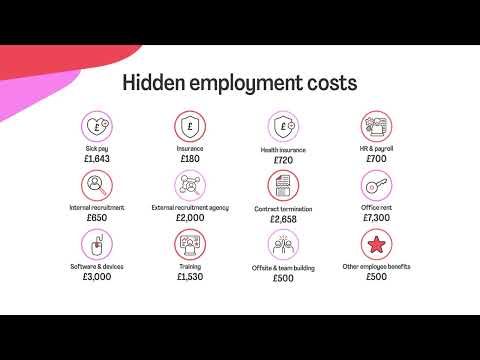
Hidden employment costs
- Sick days. The average employee in the UK has 5 sick days per year. Assuming the employer has a sick pay scheme, that’s £1,600
- Insurance. Companies must have a minimum £5M Employer Liability Insurance. The costs vary depending on the company, but the average for office work is £90, plus £90 for Cyber, which brings us to a total of £180£180.
- Health Insurance. It varies depending on company size, employees' age, location, etc. A reasonable average is £60 per month per employee or £720 per year.
- HR and Payroll. Let’s assume that one HR manager can handle 100 employees. With an annual salary of £60,000, that’s an extra £700.
- Recruitment. Let’s assume one internal recruiter for 100 employees, with a £55,000 gross salary. That’s an extra £650 annual cost per employee.
- External recruitment. The average employee tenure is three years. If half of the recruitments are handled by external recruiters, invoicing a £12,000 fee per recruitment, it’s an additional £2000 per year per employee (12,000 divided by 3 years x 50% of employees).
- Contract termination. Of all employees who leave a company, roughly 20% are let go by the employer. Let’s take an average of three months of paid notice period and 3 months of severance. The yearly cost per employee is: monthly salary x 6 months divided by 3 years tenure * 20% of employees. That’s £2,700 per year.
- Office rent. It depends on the location, of course. For example, it can stand at £700 per person per month in London (but it can go way higher depending on the area). At the moment, the average in the UK is £600.
- Software and IT devices. Think about it - £1000 per laptop amortised over 3 years, several software tools (Microsoft, Salesforce, Dropbox, SAP, Zendesk, DocuSign, HubSpot, NetSuite, Adobe, Kandji, Slack, Notion, Zoom, Canva, Twilio, Workday...) - it’s a very long list. Let’s take a total of £500 per employee per month. Even if it's underestimated, we are still looking at £3000 per year.
- Training: £1500.
- Office life, team building: £500.
- Other employee benefits (gym, food, cycle to work…): £500.
Here we are: a total of £20,000 in hidden costs (28% of the gross salary) and £15,000 in direct employment costs (21% of the gross salary). This means that on a £70,000 salary, you need to add roughly 50% of additional costs to your salary, or £35,000.
Here’s what you’re getting with a freelancer :
- No employment overheads
When you hire a full-time employee, you carry many hidden costs: employer National Insurance / social contributions, pension contributions, paid holiday and sick leave, maternity/paternity leave, training, onboarding, termination notice, liability insurance and more.
- No equipment or training costs
Freelancers come fully equipped and keep themselves up to date. You avoid supplying laptops, mobile phones, subscriptions, software licences, training budgets, and you steer clear of the fixed cost of internal onboarding and infrastructure.
- Expertise on tap
Many freelancers are seasoned professionals with deep sector knowledge, multiple-client experience and proven track records. You’re paying for speed, depth and results.
- Flexibility & scalability
You can scale up or down quickly. If things change, you don’t carry the long-term commitments associated with salary, pensions, redundancy or the like.
- Minimal management overhead
Freelancers typically manage their own time, deliverables and admin. You pay for output, not presence. You reduce HR burden, don’t need to manage holiday or sick-leave, and can focus internal resources elsewhere.
The numbers: how to compare fairly
Let’s follow a simple logic. If you have an employee earning £70,000 gross per year, the actual cost to you is higher in reality. Once employer taxes, pension, training, equipment, recruitment, and overheads are included, the cost can rise to over £100,000 in the UK context.
When it comes to freelancer day rate, once you add a “flexibility premium” (we suggest ~20%), you get a fair daily rate calculation. That means a freelancer charging around £460-£550/day is not “double” the cost of an employee. Indeed, when you factor all hidden costs and risk, the differential is much smaller – circa 12% more.
Myth busted: “Freelancers cost twice as much”
The myth persists because many hiring managers use a simplistic rule: take the salary, divide by 220 working days and assume a comparable daily rate. That misses the employment overhead and risk premium built into freelancer rates.
So, if someone tells you “A freelancer will cost you twice as much”, you now have a counterargument.
What this means for you
If you’re a business procuring talent:
- Stop comparing freelancer rates to raw salary-divided numbers. Instead, calculate the loaded cost of an employee (salary + employer taxes + overhead) and then factor in a flexibility/risk premium for a freelancer.
- Recognise that paying a freelancer a higher day rate can yield immediate access to expertise, faster onboarding and fewer hidden costs.
- Understand that a freelancer is not just more expensive labour - you’re buying speed, agility and outcome-focused results.
If you’re a freelancer:
- Be confident in your day rate. You’re not simply taking a salary and dividing by days. You’re covering your business costs, training, risks and ‘idle’ days between contracts.
- Remind clients of the value you bring: no onboarding, immediate impact, specialist insight, and no long-term commitment (if required).
- When you encounter clients fixated on “it must be cheaper than salary,” walk them through the hidden cost mechanics and show how the rate actually compares favourably.
Hiring a freelancer shouldn’t be about choosing between “cheap vs expensive”. Yes, freelancers often charge more than an equivalent employee’s hourly rate. But that’s because you’re getting more than just labour - you’re getting a self-contained business, ready to deliver, with its own overheads borne by the contractor. When measured fairly, the difference is often far less dramatic than the “double” myth suggests.
Ready to find your next talent?
At Malt, we specialise in matching you with the top talent to solve your every business need. Speak with our team to find the skilled experts today.