Getting started
What do you feel when you hear this: “Everyone does their part, but no one owns the whole”?
If that phrase resonates with you, chances are you’ve seen it play out in your organization. And if so, this reflection might be useful.
Let’s talk about what goes into releasing products. They’re not just something we deliver, but they represent the interconnected work that naturally links different parts of the organization. Building a product involves strategy, design, technology, operations, sales, and other areas, and ultimately customer experience, all moving together in the same direction.
A product cannot exist inside a silo. It’s a living system where every decision in one area affects the others. The challenge grows when this work expands across regions, markets, and teams. Coordination becomes harder, misalignments appear, and the very connections that make a product strong can also make it fragile without good orchestration.
There’s a documentary called The Most Unknown, where nine scientists from different fields spend time exploring one another’s work. They’re all highly specialized, but the real breakthroughs happen in the moments when their worlds connect. I bring this up because product work is much the same: strategy, design, technology, operations, and customer experience each hold deep expertise, but often work in isolation. Without orchestration, these areas remain separate. We see talented teams working hard, yet disconnected. Energy is spent navigating complexity instead of creating value. In large, layered organizations, connecting these specialties into one coherent effort isn’t optional, it's essential.
Now, let’s zoom into product teams. We often work in small units (following Jeff Bezos’ “two-pizza rule,” a principle he introduced at Amazon in the late 1990s). The idea was that a team should be small enough to be fed with two pizzas, typically around 7 ± 2 people. But complexity increases when a product spans multiple functionalities, regions, or business areas. As companies scale across countries and departments, product roles evolve into orchestration roles by necessity.
We sometimes mistake the product for the process. But in reality, the experience is also shaped by many non-technical elements. That’s why orchestration is not just helpful, it's vital. Many product managers don’t view the digital product as part of a broader, holistic experience. While some adopt service design mapping to gain a wider perspective, alignment issues still persist especially when key contributors to the experience are excluded or lack context about decisions made elsewhere. As a result, these contributors often reject solutions that feel imposed, leading to what we commonly interpret as “resistance to change.” But in reality, it’s not resistance, it's a response to being disconnected from the why behind the decisions.
When governance models are in place and structures appear logical and well-designed, outcomes can still fall short. Why? Because orchestration isn’t just about structure, it’s about connection, context, and coherence. We know that gathering everyone’s input can sometimes feel time-consuming or inefficient, but when we’re talking about orchestration, we’re talking about the need for meaningful engagement and smarter change management. Without it, decisions lack depth, roles remain disconnected, and the experience suffers, not because people resist change, but because they were never truly part of it.
Let’s look at a few real-life examples to illustrate this fragmentation:
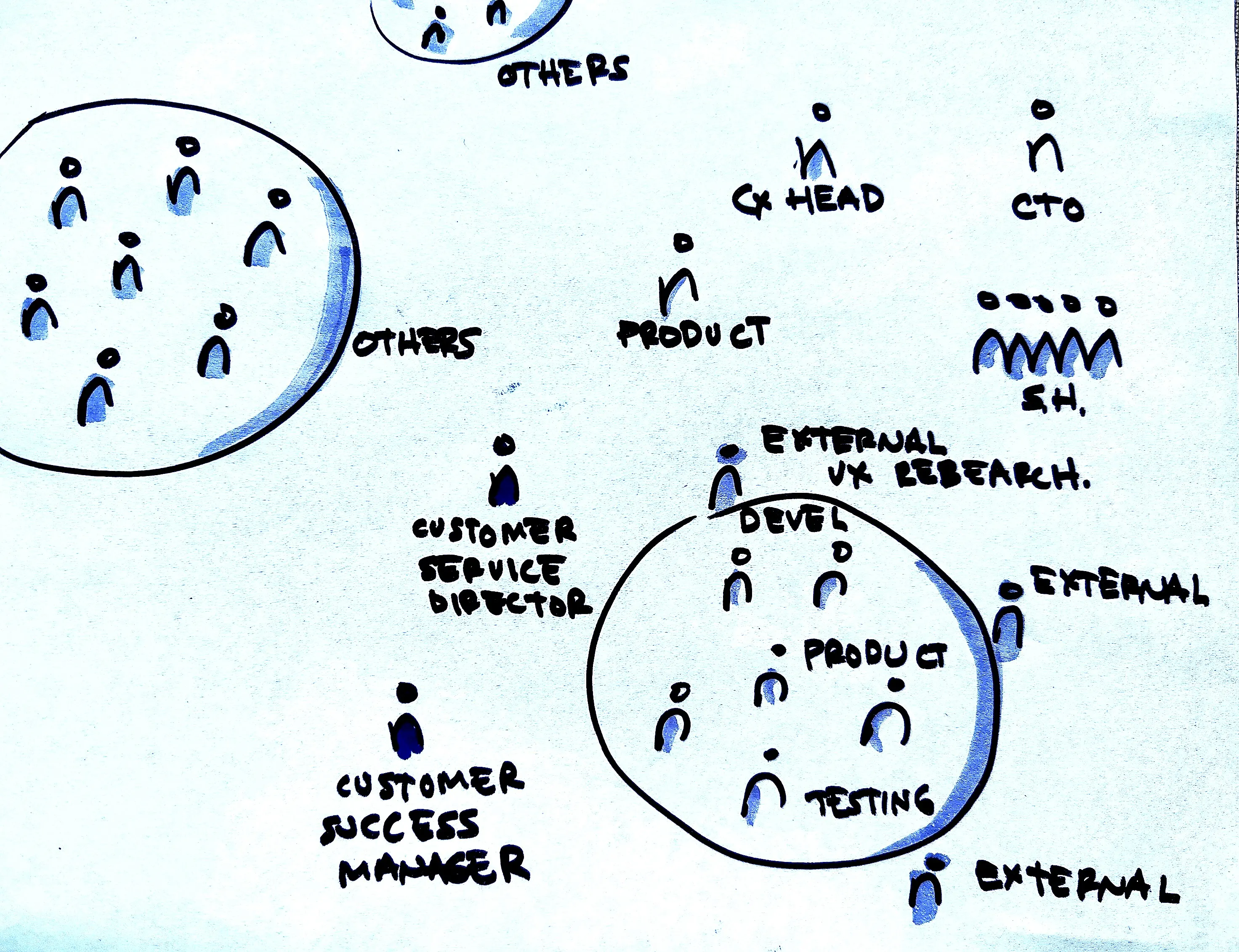
Visual Orchestrated Change: The image above provides a general perspective on the need for orchestration, but let’s dive deeper into specific examples.
First fragmentation case
Involving: UX Designer (freelance) – Technical Lead (team member)– Product Owner (team member) - Stakeholder with high influence
In this scenario, a high-level stakeholder pushes for a sleek new interface. The Product Owner agrees and briefs a freelance UX Designer, who delivers a beautiful prototype, however it doesn’t take into account any internal tech constraints. The Technical Lead flags major feasibility issues, but wasn’t involved early on due to cost concerns - reviewing technical impact too soon is often seen as unnecessary overhead.
By the time the issues surface, expectations are set, and the team is forced to make compromises. The result? A fragmented effort, where design, tech, and business goals are misaligned. The team delivers functionality with a beautiful UX and makes the stakeholder happy but fails to address the users’ real needs. In reality, no one challenges the tension with the stakeholder, so the experience remains fragmented. Experience isn’t just visual, it’s systemic. Without early orchestration, even the best ideas can turn into costly mistakes.
Second fragmentation case
Involving: Product Owner (Team member) – UX Researcher (Role under the Cx Head) – Business Analyst (Team member)
In this scenario, the CX Head makes confident promises to senior stakeholders about improving the customer experience. Meanwhile, the UX Researcher conducts thorough user interviews and uncovers critical pain points, but the findings are never presented to leadership. They remain buried in internal documentation, disconnected from strategic decisions.
The Product Owner receives a brief focused on delivery, and the Business Analyst builds workflows based on that brief. The team’s objectives shift toward executing the workflow and writing quality code, rather than solving the actual user problems uncovered by research. As pressure builds to fulfill the CX Head’s promises, the team delivers what was asked for, but not what was needed. The result is a polished implementation that misses the mark, because orchestration was missing. The user voice was lost, the leadership vision was disconnected from reality, and the team was aligned around tasks, not outcomes.
Let’s move into the final case, a broader one that better illustrates the depth of fragmentation.
Third fragmentation case
Involving: Service Designer (Consultant) – Data Analyst – Product Owner (team member) - Customer service director
The Service Designer maps the customer journey and identifies a key pain point in the support experience. The findings are shared with the Product Owner, who loops in the Data Analyst to validate the issue with behavioral user data.
Meanwhile, the Customer Service Director (excited by the promise of AI) expects that the latest technologies will magically solve everything. He pushes for chatbot implementation and predictive routing, assuming it will instantly improve satisfaction. But he doesn’t understand the complexity: the data isn’t clean, the models aren’t trained, and the experience isn’t orchestrated. The Service Designer’s insights are ignored, the Data Analyst’s warnings are overlooked, and the Product Owner is caught between pressure and feasibility.
Instead of aligning around what’s possible and valuable, they chase a solution that’s disconnected from the real problem. Expectations rise, results disappoint, and the customer remains stuck in the same frustrating loop.
Orchestration and innovative change is needed with fragmentation
We try to create universal methods to coordinate these roles, but every organization has its own structure, its own language, its own rhythm. Coordination becomes hard, and empathy - our most powerful tool for alignment - gets lost in translation, especially when you have many different teams that speak different "languages", and everyone interprets similar terms and meanings differently.
By coordination, I mean both the formal and informal processes that enable collaboration between knowledge areas. This includes role definitions, shared work artefacts, processes, and communication flows.
Of course not every organization faces the same issue, but Product Managers often focus on digital product development or technical tasks rather than the full customer experience. In many cases, this is exactly what organizations expect from them: to concentrate solely on the digital product, or to be fluent in technical jargon when working with IT leads. But behind the scenes, there are hidden handoffs to roles like customer service, contact centers, and operations that are rarely formally orchestrated. These processes are often invisible, yet they have a direct impact on the experience, and when they’re not aligned, even well-built products can lead to poor outcomes.
Instead of aligning these roles around a shared understanding of the experience, teams operate in silos. Expectations diverge, context is lost, and the experience suffers. Sometimes we collaborate across knowledge areas and everything looks perfect: a well-structured process, clearly defined roles in HR, even compliance mechanisms to ensure smooth operations and avoid penalties. But the truth is, sometimes the outcome is poor despite the apparently solid structures for collaboration.
In the end, building great products isn’t just about delivering features - it’s about designing coherent experiences across roles, systems, and touchpoints. When teams operate in silos, even the most well-intentioned efforts can lead to misalignment, wasted energy, and broken experiences.
Orchestration is the missing link explaining why CX and product experience fail in most organizations, because it’s about constructing the whole reality and developing a deeper understanding of it. When we say “connect strategy with execution, digital with human, and roles with context,” we are talking about the existing fragmentation and bias between the different product roles. It’s not about adding more process; it’s about fostering shared understanding, empathy, and clarity.
This reflection isn’t just about identifying gaps, it’s about offering a way forward. If we want to move from fragmented delivery to meaningful experiences, we need to orchestrate with clarity, empathy, and context. That means uncovering the hidden processes that quietly shape outcomes, aligning roles around shared purpose, and making leadership not just about direction, but about coherence.
Because when we design with coherence, we don’t just fix broken systems, we build experiences that make sense. Experiences that connect strategy with reality, roles with empathy, and decisions with their deeper “why.”
So how do we move from fragmentation to orchestration? That’s where my approach comes in. If you're curious about how to drive organic change using AI, uncover hidden processes that lead to poor outcomes, and bring clarity to leadership through experience design, I’d love to talk. Whether you’re interested in a conversation, want to be a first reader of my book, or explore new ways to orchestrate change, let’s connect.
Ulises S. Aguila
Strategic Projects & Change | Product Consult | CX-EX
This article was co-edited with human expertise and complemented by AI support using Copilot, drawing on multiple references and refined through several iterations over more than six hours of focused work.