Freelancers are increasingly filling strategic, high-impact roles. That means they deserve to be compensated not just fairly, but competitively. For clients, pricing correctly isn’t just about fairness, it’s about getting better outcomes. Underpaying often leads to mismatched expectations, slower delivery and higher churn. However, when organisations' prices are based on total value and flexibility, they attract professionals who are aligned, motivated and committed to the work.

Hiring a freelancer to cover a talent gap, whether it is for a fractional or full-time position, comes with real advantages: speed, flexibility and access to top-tier skills without long-term commitments. But there’s one question that still trips up many companies - how much should you pay them? 

Every company has salary grids. They are an essential tool to: 

  • Compensate employees fairly across an entire organisation. Grids are carefully crafted to be in the same range (ex., top quartile or industry average) across different departments and countries 
  • Simplify the hiring process and avoid lengthy discussions for each new hire. For each position, there is a salary range based on the candidate's experience. Simple. Straightforward. 

But I never came across a company which had a grid for freelancer rates. Surprising, given they account for 25% of the workforce in the tech and creative space. 

Why the ‘salary-divided’ model doesn’t work 

Let’s say you want to hire a freelancer to replace a backend developer who is away for 6 months on parental leave. What can you suggest to the freelancers you reach out to? 

Too often, hiring managers look at an employee’s annual salary and simply divide it to get a rough daily rate. For example, if a role is salaried at £70,000 per year, they might assume a fair freelance rate is £5,800 per month, or around £290 per day for 20 working days.

Seems logical, right? Not quite.

This approach ignores the true cost of employment on your books. The reality is that the real cost of an employee is far higher than their gross salary alone. For instance, hiring someone at £70,000 gross per year means the company’s actual cost, once you factor in employer social contributions, recruitment, pension, paid leave, sick days, training, equipment and overheads, can jump to over £100,000. 

Freelancers, on the other hand, are self-sufficient. Organisations don’t pay pension contributions, national insurance or healthcare. They are not funding their annual leave or providing a laptop and onboarding. And crucially, they are not making a long-term commitment - they’re paid for what they deliver. 

The salary-divided rate is far too low. 

Should you offer “market rates”? 

More and more you will also face cases of freelancers directly applying for full time jobs “Hey I noticed this back end developer position I am highly qualified, but I have my own company. Can I contract as a freelancer ?” given the tension on the job market the power lies with the candidates… giving them more choice of employer, but also a choice in the status under which they operate.

If you go check on Malt, the median rate is around £550 per day. It’s a bit above your budget. 2 things to consider here 

  • First, this is originally a permanent position, and the freelancer decided to apply knowing that situation. As it’s a permanent position, you can also offer more visibility on the contract duration, let’s say 6 months until you find your ultimate candidate 
  • Second, would that be fair vis à vis the rest of your team? Salary grids are created to ensure fairness and consistency in a company across all functions. And a freelancer working full time 220 days per year on £550 per day will receive 40% more (£71k) at the end of the month than an employee earning £70,000 per year (£51k take home). 

It’s totally normal for freelancers to earn more, they do not get unemployment benefits, they have their own costs (accounting, banking, equipment) and protection to pay for (healthcare, pension, insurance). But most importantly, they don’t have guaranteed work. The flip side of flexibility is security. As a client, you can end a project without cause on relatively short notice. Freelancers are not working 200 days per year in reality, as they have some idle time between contracts, they need to find clients, train themselves, etc. 

Furthermore, organisations should pay a premium for flexibility and speed. By sidestepping bureaucracy and internal bottlenecks, businesses are getting someone who’s done this role many times over across different businesses, and who can hit the ground running. 

So, how should companies price it? What is fair for the freelancer and your permanent team members? 

A smarter formula: total cost + flexibility bonus

Here’s a more accurate way to think about it. Start with the loaded cost of employment for a salaried role (in France, we call that “superbrut”) = salary + employer taxes + pension. In the UK, with a £70,000 gross salary, that would represent £85,400 (15% NIC and 7% pension).  

Bear in mind that this is not even the full cost of an employee. There are indirect hidden costs for the company that we don’t think about, but can represent easily another 20% extra cost, such as healthcare, sick pay, recruitment, HR admin, termination fee, offsites, training and software. 

Back to our loaded cost of employment, you should then add a flexibility markup to account for the short-term, low-commitment nature of freelance work. Personally, I use a markup of 20%. Note that this amount is in line with the hidden costs… 

Let’s break it down. 

The UK 

Gross annual salary for back end developer: £70,000 

Employer contributions (approx. 15% NIC + 7% pension): £15,400 

Total cost: £84,400 

Flexibility bonus (20%): £17,000 

Total freelance-equivalent cost: £102,400 

Daily rate (based on 220 days or 18 days per months 12 months/year): £460/day 

France 

Gross annual salary for backend developer: €60,000 

Employer contributions (approx. 45%): €24,000 

Total cost: €84,000 

Flexibility bonus (20%): €16,800 

Total freelance-equivalent cost: €100,800 

Daily rate : €460/day

Belgium 

Gross annual salary: €65,000 (incl. 13th month holiday pay) 

Employer contributions (approx. 25%): €16,250 

Total cost: €81,250 

Flexibility bonus: €16,200 

Total: €97,450 

Daily rate: €440/day 

The Netherlands 

Gross annual salary: €70,000 

Employer contributions (approx. 20% + 8% pension + 8% holiday pay): €25,200 

Total cost: €95,200 

Flexibility bonus: €19,000 

Total: €114,200 

Daily rate: €508/day 

These figures are, of course, approximations, but they help shift the mindset from “what’s the lowest I can pay?” to “what’s the fair, sustainable rate for this freelancer’s contribution?” 

These figures are higher than by simply dividing a salary by the number of days. But they are lower than typical marker rates : they should only be used when you are hiring a freelancer for a long assignment with a reasonable notice period! If it’s a short assignment or a deliverables based project, you should definitely pay the market rate given the risk is much higher for the freelancer. 

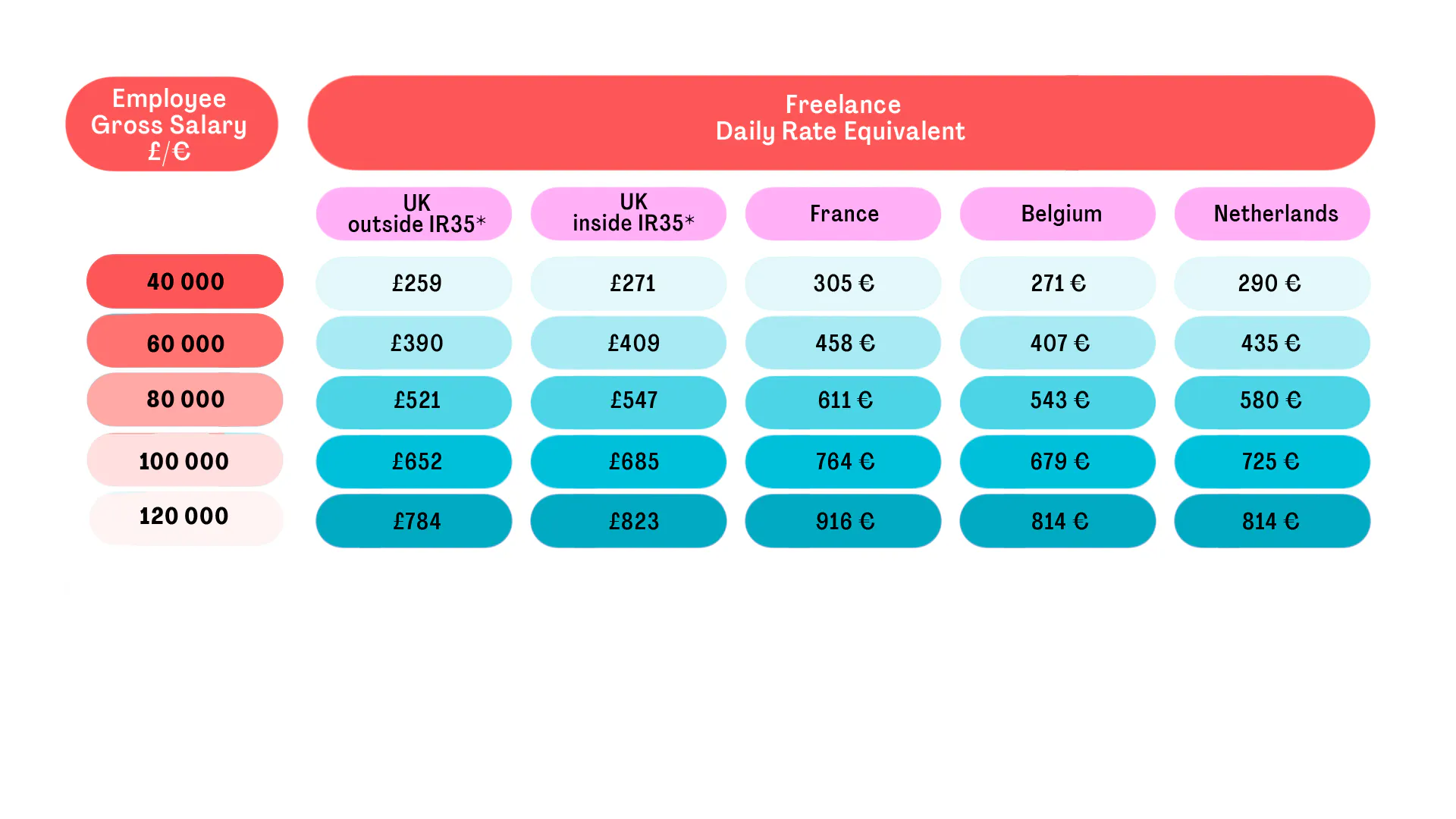
**"IR35 refers to UK tax legislation designed to combat tax avoidance by workers providing services through an intermediary (e.g., a limited company) when their role resembles employment. ‘Outside IR35’ means the freelancer is genuinely self-employed (client pays their gross rate). ‘Inside IR35’ means the freelancer is deemed an employee for tax purposes (client covers employer taxes). Rates differ accordingly as inside IR35 is taxed higher. We propose to add 5% to the freelance rate here. And employer will also be liable for an extra 15% NIC " 

Ready to price freelancers properly? 

At Malt, we help organisations find top freelance talent across Europe. Our new Freelance Conversion Grid translates your salary bands into market-aligned daily freelance rates, by country and role. 

So, whether you're hiring a data scientist in Paris or a marketing lead in Amsterdam, you'll know exactly what to offer. 

Get in touch to access the grid and start working with freelancers the smart way.