The "Prompt" is no longer enough: welcome to the era of orchestrated AI!
Picture this: a senior consultant spends 4 hours juggling a 50-slide PowerPoint deck, three 45-minute Zoom transcripts, and a stack of market research PDFs just to write a cohesive client brief. This is the daily reality for thousands of decision-makers. Today, many think they can solve this problem by dumping everything into ChatGPT. Fundamental mistake!
The result of a single prompt on a massive context is often a "lukewarm soup"—lacking precision on KPIs and nuance on budgets. During his recent AI Malt Academy session, Thibault Boutet demonstrated that in this year 2026, AI is no longer "prompted": it is orchestrated. To move from experimentation to industrial ROI, we must shift from conversational AI to Agentic AI.
The glass ceiling of the single agent
Entrusting the generation of structured business briefs to a single LLM agent (even the most powerful on the market) means ignoring the structural limitations of current AI. Thibault identifies three insurmountable barriers to the "Single Prompt" approach:
- Context saturation (attention loss): even with 1M-token windows, models suffer from the "Lost in the Middle" phenomenon. Crucial budget details buried on page 42 get mixed up with brand objectives from page 3.
- Reasoning instability (reasoning drift): a single agent has to maintain logical consistency across 10 pages. The longer the task, the higher the probability of cross-hallucinations.
- The "black box" effect: if the final brief is mediocre, it is impossible to diagnose the failure. Was it the source analysis? The synthesis? The formatting? Without modularity, there is no audit trail.
The Vision: moving from a single prompt to industrial AI
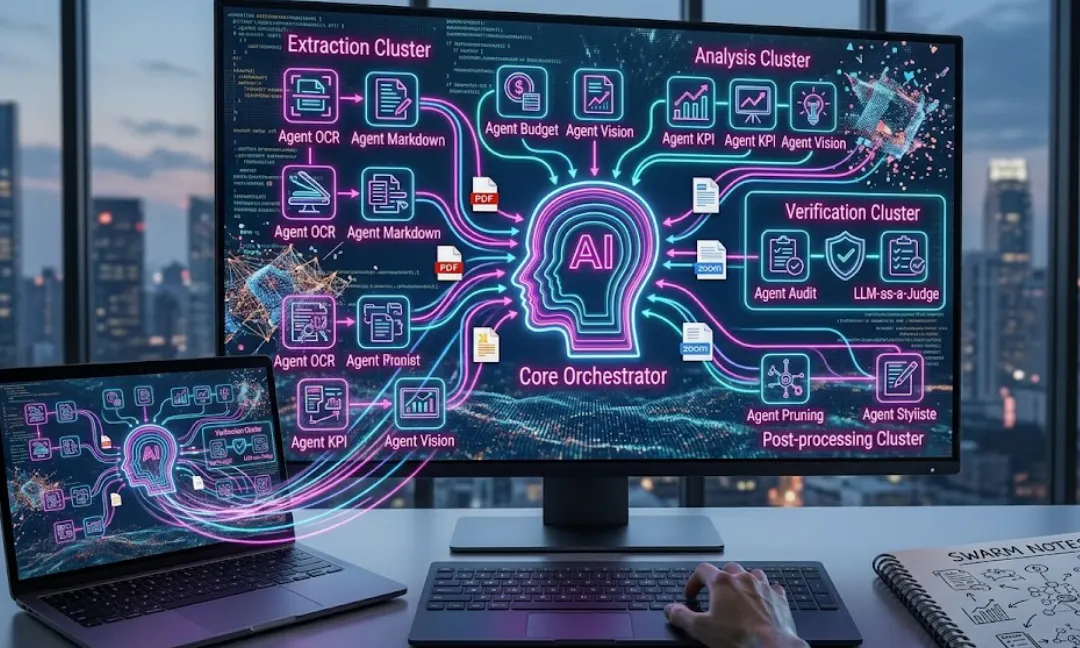
To overcome these limits, the challenge is no longer to write the "perfect prompt," but to design a true algorithmic assembly line. This is the approach developed by Thibault: a system of 15 specialized sub-agents, where each entity automates a human micro-task with a level of reliability impossible for a single agent to achieve.
This architecture relies on a strict 4-step cycle:
This is exactly where the value of an AI Engineer comes to life. Unlike a rigid "turnkey" solution, Thibault decomposed the AI's brain into 15 autonomous work units.
The methodology: Thibault's "swarm stack"
To transform gigabytes of heterogeneous data into "strategic gold," Thibault implemented a framework built on four pillars.
1. The Ingestion pipeline: OCR and Markdown
Before the AI, there is the data. The first technical challenge is making the unreadable readable: complex tables in PDFs and diagrams in slides. Thibault uses Mistral OCR.
Why? Because it transforms visual documents into structured Markdown. Markdown is the native language of LLMs; it preserves information hierarchy (headings, lists, tables) where raw text flattens everything. Furthermore, it allows linking every AI claim back to its original source page, guaranteeing total transparency and traceability for the client.
Expert Tip: Never feed a raw PDF to an agent. Convert it into tagged text first. This reduces noise by 40% and ensures absolute fidelity to the source data.
2. Multi-Agent architecture: the "league of experts" concept
Instead of a single massive prompt, Thibault uses an architecture where each section of the brief (objectives, analysis, budget, success metrics) is managed by its own dedicated agent.
- Dedicated YAML files: each agent has its own configuration file to isolate business instructions. The "Budget" agent is prompted to be meticulous and skeptical about numbers, while the "Vision" agent is configured to be creative and concise.
- Data sovereignty: each agent only receives the data segments necessary for its specific task. This prevents cognitive pollution and optimizes token costs.
3. The minimalist toolkit: "the Fantastic Four"
Thibault advocates for architectural simplicity to prevent the system from becoming unstable. His agents only have access to 4 functions (tools) to interact with the environment:
> Read_file = reads a source document with targeted extraction without saturating the global context.
> Write_file = persists data into structured Markdown.
> Search_files = targeted smart search across all source documents.
> List_files = inventories all available resources.
4. "LLM-as-a-Judge": the industrial-grade quality guardrail
This is the centerpiece of the system. To ensure the brief is deliverable without requiring exhaustive human proofreading, Thibault integrated a critic agent.
This agent does not write anything. Its sole role is to "score" the work of the other 14 agents against a strict rubric of criteria (accuracy, tone, format). If a section scores below 8/10, it is automatically sent back for regeneration along with the critic's feedback. This is the principle of recursive self-correction.
The results: from hype to efficiency
Implementing this "Swarm Stack" goes beyond mere automation; it radically transforms project economics:
AI is no longer a R&D topic, it’s infrastructure
The era of demo-stage AI is over. What Thibault Boutet demonstrates is that the success of an AI project no longer depends on the raw power of the model, but on the intelligence of its orchestration.
For companies, the message is clear: value no longer resides in basic "Prompt Engineering," but in the ability to build multi-agent systems capable of replicating complex human workflows with 99% reliability, while tailoring them to the specific nature of the business.
About Thibault, freelancer on Malt
Thibault Boutet is a freelance AI Engineer specializing in production-grade AI agents, with international experience across Europe and the United States.
He previously worked in the United States at Siemens Healthineers, where he developed deep learning models and LLM-based solutions to analyze large-scale clinical and medical imaging data. This experience allowed him to work on applied AI problems in a demanding, research-driven industrial environment. Today, he works as an AI Engineer collaborating with companies such as Barnacle Labs in London, where he designs and builds applications based on LLM agent architectures and multi-agent systems to automate complex workflows, particularly in the pharmaceutical domain. He also shares his expertise through conference talks and technical articles focused on LLM architectures and production AI agent systems.
Ready to scale your business?
👉 Need an architect? Check out Thibault Boutet's profile on Malt.
👉 Explore top tech talent: Discover our best AI Engineers and Data Scientists.
👉 Stay ahead of the curve: Don't miss the next AI Malt Academy.