How I Learned to Vibe Code, and How It Changed the Way I Work
Published :
12 Jun 2026
Updated :
12 Jun 2026
10 mn
Malt's Editorial Collective gathers insights from our exceptional community of freelancers. The views and opinions expressed in this piece are those of the author, and are published to encourage a diversity of perspectives and insights.
Romain Malengrez
UX/UI Product Designer
Has this ever happened to you: you receive a project brief that you know you're capable of, although you don't totally master every one of the skills necessary from the start. You want to give it a shot, anyway - but you need to convince the client that you're up to the task. Here’s how you can confidently step up and build trust with your client from day one.
As freelancers, we're constantly learning and pivoting along with the skills economy. Last year, I did exactly that - by mastering vibe coding for a new client, on a project that was near and dear to my heart.
In this article, I'll share my key learnings to help you:
Embrace projects that stretch your skills: Even if you haven't mastered every technical requirement from day one, your core expertise and drive to learn can unlock incredible new opportunities.
Expand your creative control with vibe coding: Discover how combining your existing skills with AI tools empowers you to build complete, live products and collaborate with clients in real-time.
Build client trust through transparent learning: See why bringing a concrete upskilling plan to the table turns potential knowledge gaps into a foundation for a strong, successful partnership.
My advice for freelancers considering the same approach: be transparent about what you know and what you're learning. Have a concrete learning plan ready: knowing exactly how and when you'll bridge the gap gives your client confidence that the risk is managed. Let's dive in.
Background
Back in 2002, I sailed across the Atlantic on a 9-month trip with my family on a 45-foot catamaran from the shipbuilder, Grand Large Yachting. We were thrilled by this sailing journey as we discovered many islands and countries across the North Atlantic Ocean. This early taste for adventure certainly influenced my freelance career, but I did not expect at the time that 23 years later, I would end up building a dedicated platform for the Grand Large Yachting sailing community.
As a Product Designer with 6 years of experience crafting SaaS products, I have been freelancing for the past 2 years. My job is to understand what users need and design interfaces that serve them well. Until recently, my work would stop at the design phase — and I would hand off high-fidelity mockups to developers and hope the final product matched my vision. All that changed when I discovered vibe coding.
A brief that felt personal
In their brief, Grand Large Yachting was looking for someone who could build a crew exchange platform from scratch on Lovable as they had already tested this vibe coding tool in the past. They also wanted a freelancer who had strong UX/UI design skills, which validated my assumption that the market is looking for this hybrid profile, the designer who builds. My Malt profile was a natural fit, as I had both of these skills front and center.
After an initial discussion with the project stakeholder and before sending a proposal, I built a first version of the website’s homepage on Lovable to showcase my design and building skills. Besides my sailing background, showing my creative potential to the client with such a tool before agreeing on a quote definitely set the foundations of our collaboration. It was an early proof of how I could address the project's requirements within a short timeframe.
The brief was straightforward but meaningful: building a place where sailboat owners could describe their sailing plans and the kind of crew they were looking for, and where crew members could showcase their experience, availability, and destinations. Boat owners and crew members needed to:
create and update their profiles;
share their intended sailing plans or availabilities;
browse listings with detailed filters (departure dates, sailing zones, languages spoken, experience level, boat type);
reach out to each other via email — no built-in messaging system was required for this MVP.
I immediately felt excited to build a solution that would bring together boat owners and crew members who share a passion for the open sea. For me, this was more than a client brief. It was a chance to build something for a community I once belonged to.
For me, this was more than a client brief. It was a chance to build something for a community I once belonged to."
Romain Malengrez
UX/UI Product Designer
Taking on the challenge
As a Product Designer, I had already learned the basics of Lovable, and was comfortable building polished, modern frontends with this AI-powered web builder: landing pages, listing views, profile pages, responsive layouts. I could already see what's possible when design and code speak the same language. With my UX/UI skills, I could deliver professional-looking interfaces in a fraction of the time traditional development would require.
But this project for Grand Large Yachting demanded more than a beautiful frontend that matched the brand guidelines of my client. It needed a real backend: user authentication, a structured database for crew and boat profiles, filtered queries, and data persistence.
I was upfront with my client that I would need to level up on other parallel tools like Supabase, an open-source backend platform I had never worked with before. I wanted to learn this tool and the best practices around it. I trusted my ability to learn fast, and as soon as the project started, I enrolled in a bootcamp to bridge the gap before the first client delivery.
I was upfront with my client that I would need to level up on other parallel tools I had never worked with before... I trusted my ability to learn fast, and as soon as the project started, I enrolled in a bootcamp to bridge the gap before the first client delivery."
Romain Malengrez
UX/UI Product Designer
The turning point: a bootcamp that changed everything
Instead of spending months learning backend development through traditional courses, I enrolled in the IQ Project bootcamp, an intensive program structured over 8 evening sessions, specifically designed to teach the full vibe coding stack: Lovable, Supabase, Cursor, and more.
The bootcamp was built around a simple but effective principle: you learn by building your real project, not through abstract exercises. And I had the perfect real project to work on. From day one, I was applying what I learned directly to the crew exchange platform I had started building.
Within days, I went from "I don't know how Supabase works" to confidently setting up email authentication so users could create accounts securely, and building the database structure to store profiles. Think of it as the engine running behind the scenes: it was handling user accounts and data storage for me, while I focused on the product experience.
That was the turning point for me: vibe coding handed me the key to going from Product Designer to “Product Builder”. With AI, I can implement the design vision of a fully functional product myself without handing off high-fidelity mockups to developers.
Building the product from vision to reality
I kicked off the project by asking the right questions. In the first workshops with the client team, I focused on understanding the community before touching any interface:
Who are the two main user profiles, and in what real-life situations will they reach for this platform?
What information do they need to share for upcoming trips or availabilities?
What filters will each user type rely on most to find what they are looking for?
How do I create a proper database structure by addressing potential use cases like allowing users to switch between a boat owner profile and a crew member profile under the same account?
From there, I mapped out the user journeys. Boat owners would create a profile with their personal details and boat information — brand, model, number of cabins, photos — then post a listing with their sailing plan and crew requirements. Crew members would build profiles with their experience level, languages spoken, availability windows, preferred destinations, and a personal introduction.
I designed and built with Lovable the full user-facing experience: a welcoming homepage, the registration and login flow, listing pages with advanced filters, detailed profile pages, and user dashboards so boat owners and crew members can manage their listings. I adapted the website’s responsiveness so boat owners can browse on their phones between two stopovers. Lovable allowed me to iterate fast and get rapid feedback from my client. The result was a modern, responsive interface that matched Grand Large Yachting's brand identity.
Training the client: questions that guided the handover
The crew exchange platform had to be built on Lovable to be later maintainable by my client team. Therefore, the deliverable went beyond the platform itself. Because Lovable is designed to be accessible to non-developers, I was able to train the Grand Large Yachting team to handle basic maintenance and updates themselves.
I organized hands-on workshops to make the client team autonomous. As I prepared these sessions, I asked myself a set of questions that any freelancer delivering a vibe-coded product should consider:
What are the most common changes the client will need to make after I leave?
Which parts of the tool are intuitive enough to explain, and which need guided practice?
What could go wrong if someone edits something without understanding the structure?
How do I give the client confidence to make changes without fear of breaking things?
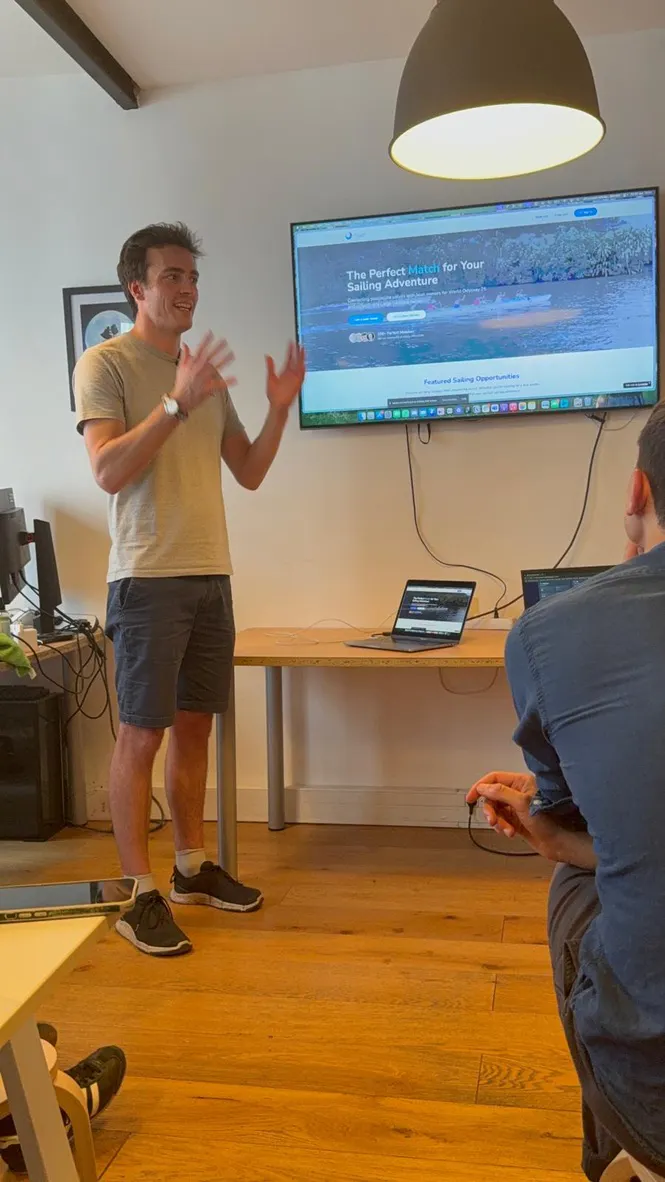
In the first workshop, we did a walkthrough of the platform and how Lovable and Supabase work together. I showed them how to make small changes, update content, and understand the project structure. In the second workshop, I gave them a hands-on session where team members could make changes themselves while I guided them.
By the end of the handover, the client was not just satisfied with the platform — they were empowered to maintain it. That level of autonomy is something traditional development rarely offers to non-technical teams.
The vibe coding shift in my freelancing career
Looking back, this project marked a significant shift in how I see my own work.
Before discovering vibe coding, I would have designed the user experience for this platform and then handed it off to a developer to build. I would have had limited control over the final result, and the feedback loop between design intent and live product would have been slow and unpredictable.
Today, I can deliver a project from user research to live product, and with a level of quality that genuinely surprises clients. I can test with real data, catch UX issues in a live environment, and iterate on the spot.
The vibe coding approach, combining AI-powered tools like Lovable with a robust backend like Supabase, has fundamentally expanded what I can offer as a freelancer. I would encourage every fellow freelance designer to work on a vibe coding project even if they don’t feel completely ready. The learning curve is shorter than you think, and engaging with a community of builders like IQ Project can definitely unlock an entirely new category of projects for your freelance practice. In fact, the Grand Large Yachting platform is now my proof of concept, and it has helped me land other vibe-coded projects since.
For potential clients: if you have an idea for an MVP you want to bring to life quickly, this is exactly the kind of project I now thrive on as a new Lovable ambassador.