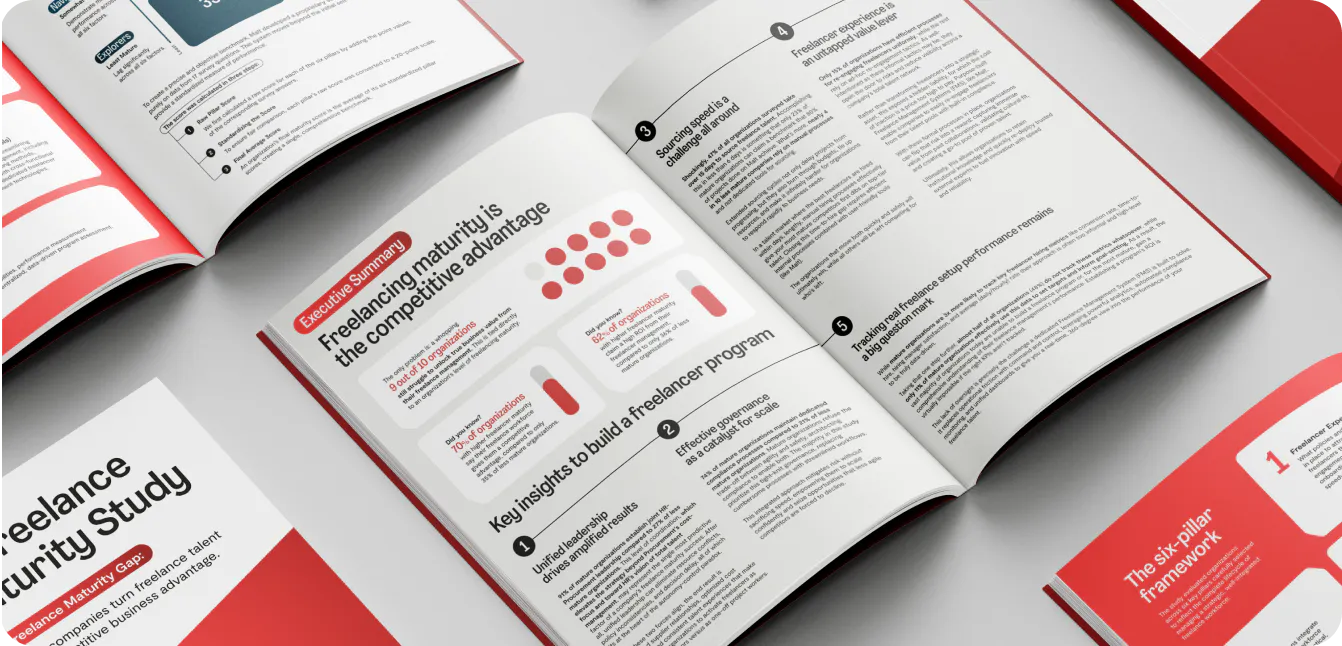

A fundamental workforce shift is rendering traditional talent management models obsolete. By 2025, the number of freelancers globally is expected to exceed 1.57 billion, meaning nearly 47% of the world's workforce will operate in some form of freelance capacity. As companies increasingly turn to freelancers to access specialized skills (88%), scale for workload peaks (68%), and cover workforce gaps (54%), the competition for top independent experts has never been fiercer.
Laura B.
Content Marketing Specialist at Malt
In this market, the best independent talent is selective. They choose not only where they are visible but, more importantly, which clients they want to work for. While organizations invest heavily in sourcing talent, they often lose the actual war for talent right at the onboarding phase.
The "Freelancer Experience" remains the most overlooked differentiator. Even companies that recognize the strategic value of an external workforce often fail to retain their top performers because they rely on outdated systems designed for a different era. How can you ensure that elite experts continue to choose your organization?
Bridging the gap: evolving systems for independent talent
Many organizations attempt to run their contingent workforce programs using a Managed Service Provider (MSP), a Vendor Management System (VMS), or both. While these foundational tools were designed primarily to manage staffing suppliers, a challenge arises when applying them directly to a direct-sourcing relationship with external independent talent. This structural mismatch can create friction, resulting in a poor user experience for hiring managers and freelancers alike. The data reflects this: this friction drove VMS satisfaction to a -35 Net Promoter Score (NPS) and MSPs to -29, according to 2024 SIA data. By bridging existing systems with more intuitive processes, organizations can ensure that top freelancers aren't driven to look for easier, more modern clients to work with.
The 84% retention crisis: Losing your alumni
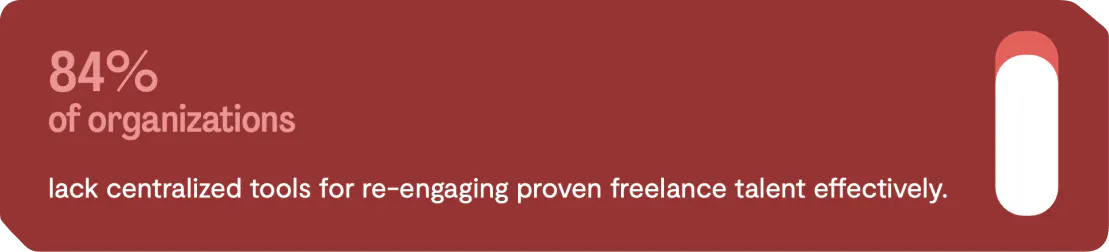
When you provide a poor experience, you do not just lose a freelancer for one project, you lose them for good. The most overlooked differentiator is the freelancer experience, as 84% of companies lack the right tools to re-engage proven talent.
Currently, only 16% of organizations have efficient processes for re-engaging freelancers, while the rest rely on ad-hoc tactics. Every time a company fails to easily re-engage an "alumni" freelancer, they bleed valuable institutional knowledge. Organizations must ask themselves: are you constantly spending resources to source new faces while letting validated, trusted experts, who already have a proven cultural fit, walk out the door? Without centralized reporting, companies lack the top-down program visibility needed to track freelancer satisfaction and feedback, losing the pulse on why top experts choose to leave or stay.
Speed as a competitive advantage
In a market where strategies change constantly, the speed at which an organization can activate specialized expertise often matters more than its budget. Organizations with efficient sourcing and contracting processes are more likely to land highly sought-after freelance talent than those that drag the process on for days or weeks.
Surprisingly, 47% of organizations take over 15 days to source and contract freelancers. Every week spent navigating bureaucratic hurdles is a week where more dynamic competitors engage top external experts, advance their projects, and secure the market opportunity.
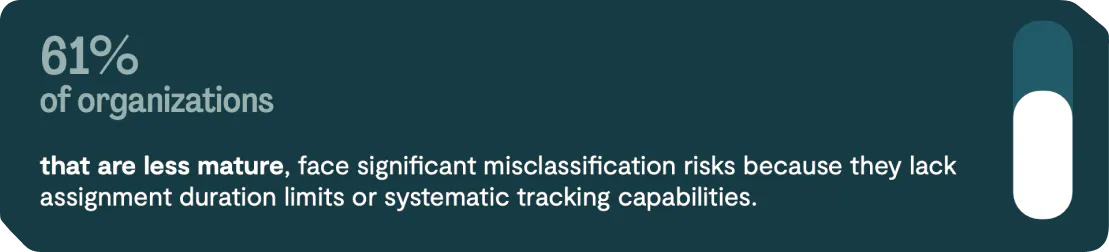
The primary culprit for these delays is often compliance, which is cited as the #1 barrier for engaging freelancers across all companies (61%). Ironically, the organizations that most resist formal compliance end up inadvertently creating the very risks they fear. Sixty-five percent of less mature companies have no formal suppliers, pushing over half (52%) of their hiring managers to rely on risky, informal solutions to find the talent they need.
The visibility gap: You cannot improve what you do not track
Even if you attempt to improve the freelancer experience, success is impossible if you cannot measure it. Astonishingly, 55% of organizations have little to no visibility into the total number of freelancers being engaged company-wide or the total spend associated with it.
Broadly speaking, almost half of all organizations (48%) do not track key metrics whatsoever, including conversion rates, time-to-hire, hiring manager satisfaction, and average daily or hourly rates. Even among the mature organizations that do track these metrics, only 12% effectively use this data to set targets and inform goal-setting. Relying on fragmented spreadsheets makes total talent reporting impossible, leaving HR and Procurement completely in the dark regarding performance measurement and program assessment.
The FMS integration: creating a unified talent engine
To close this maturity gap, organizations need a platform built explicitly for the modern freelancer. You don't have to choose just one path; organizations can adopt a standalone system or combine solutions to create a realistic, comprehensive talent ecosystem. Purpose-built Freelance Management Systems (FMS) bridge this gap and balance an organization's need for control and visibility by connecting directly to their VMS/MSP/ERP systems. By integrating these tools, organizations can maintain their core operational frameworks while offering freelancers a platform where they can get the best experience all around.
Interestingly, less mature organizations are surprisingly leading the shift to FMS (20% vs. 15% for mature companies) to source, manage, and pay talent directly.
A modern FMS like Malt transforms the onboarding and management lifecycle by providing:
Market-speed activation: 80% of client projects done on Malt are sourced within 6 days or less.
Frictionless operations: Direct communication, fast-guaranteed payments, and easy re-engagement of alumni.
Automated efficiency & 360° visibility: By integrating with procurement platforms, Malt offers automatic invoicing that is 4x faster than manual input and reduces invoice errors from 25% to 0%. Furthermore, it embeds compliance and reporting into the workflow, providing 360° analytics so leaders can manage their freelance workforce with data-driven peace of mind.
Conclusion: Scaling your external workforce
Scaling your freelance strategy requires treating independent experts as strategic contributors, not just tactical, stop-gap solutions. Having the proper tools allows organizations to retain institutional knowledge and quickly re-deploy trusted external experts to fuel innovation with speed and reliability.
Where does your organization stand when it comes to the Freelancer Experience?
Get your freelance maturity score in under 2 minutes with our online assessment tool. Benchmark your freelance strategy against 140 global organizations representing a broad cross-section of the industry.