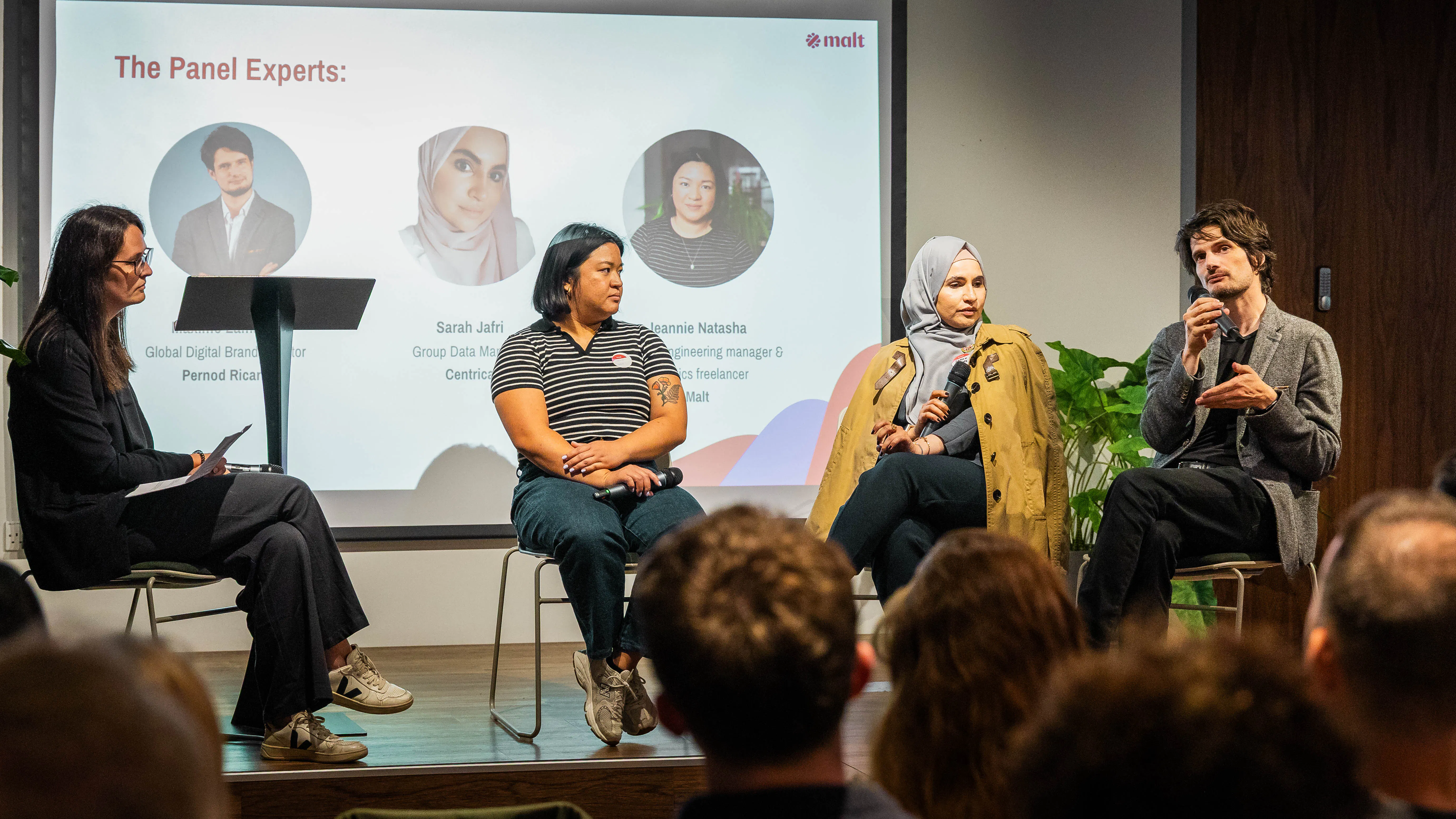
Among the speakers, we had Sarah Jafri, Group Data Manager from Centrica, Maxime Lamagat, Global Digital Brand Director from Pernod Ricard, and our own Data Platform Director, Anais Ghelfi, each offering a different perspective on how businesses are approaching AI, data and automation in practice.
Four key trends shaping the market
Drawing on insights from more than a hundred of thousand projects completed through the Malt platform, the event revealed four major patterns shaping the market:
The growing capability gap
Beneath those growth figures, however, lies a widening gap in capability. Businesses are struggling to hire experienced data engineers, data scientists and analytics leaders, even as AI ambitions grow. Many projects stall before reaching production because data remains fragmented or inconsistent. If the data isn’t clean, connected and understood, the AI project will fail before it starts.
Automation spreading beyond IT
The conversation also explored how automation is spreading beyond IT departments. Tools such as PowerApps, Make and n8n now allow finance, marketing and operations teams to design their own workflows. One example shared on stage came from Malt’s finance function, where a team member with no technical background built a simple automation for invoice handling, reducing manual work by approximately 20%. It’s a small change, but it demonstrates how accessible technology can create measurable results when paired with curiosity and initiative.
Still, there is caution against handing over too much control without guidance. New tools can be misused if teams don’t understand data quality or security risks. There is also another side of the AI debate where too many restrictions can hold organisations back. Finding that balance between freedom and governance is becoming one of the most practical leadership challenges of the AI era.
Real-world AI in action
When it comes to real-world examples, the most tangible progress is happening in support and content teams, where AI assistants are helping people work more efficiently. Automating routine service queries, for instance, has shortened response times by as much as 80%, freeing customer-facing staff for higher-value conversations. In marketing, AI tools are being used to speed up translation and content adaptation without replacing creative input.
The evolving skills landscape
Throughout the evening, the discussion kept returning to people - their skills, their adaptability, and their willingness to keep learning. However, there’s a growing gap between what employers need and what the market offers. According to our research, around 40% of the most in-demand skills today don’t exist in the current talent pool. While employers are focused on core areas like cloud security and data architecture, many professionals are racing ahead into AI-first specialisms, from LLMs to RAG and GenAI tools. That mismatch is both a risk and an opportunity. Companies may struggle to hire for the skills they need right now, but individuals who steer their learning toward real business demand will quickly set themselves apart.
Technology will continue to evolve, but progress depends on the mindset to evolve with it. The companies doing well with AI are the ones investing in good data, useful skills and a culture that values curiosity over hype.