The operationalization era: how your company can leverage independent experts to scale tech in 2026
Published :
26 May 2026
Updated :
26 May 2026
5min
The AI excitement of the past two years has officially matured. We are no longer simply experimenting with what artificial intelligence can do, we are integrating it into the very core of business operations.
Laura B.
Content Marketing Specialist at Malt
Based on millions of searches and project briefs from Malt's community of over 1 million registered freelancers and 90,000 companies, the Malt Tech Trends 2026 report reveals a definitive shift. Freelancers, who naturally operate at the intersection of multiple industries and tech stacks, act as the early warning system of the global tech ecosystem. Right now, they are signaling a massive transition: we have entered the "Operationalization Era".
At the heart of this new era is a fundamental transformation in the kind of talent organizations need to succeed. It is no longer just about adopting the right tools, it is about finding the people who can architect and govern them.
Upgrading your workforce: why your business needs orchestrators, not just builders
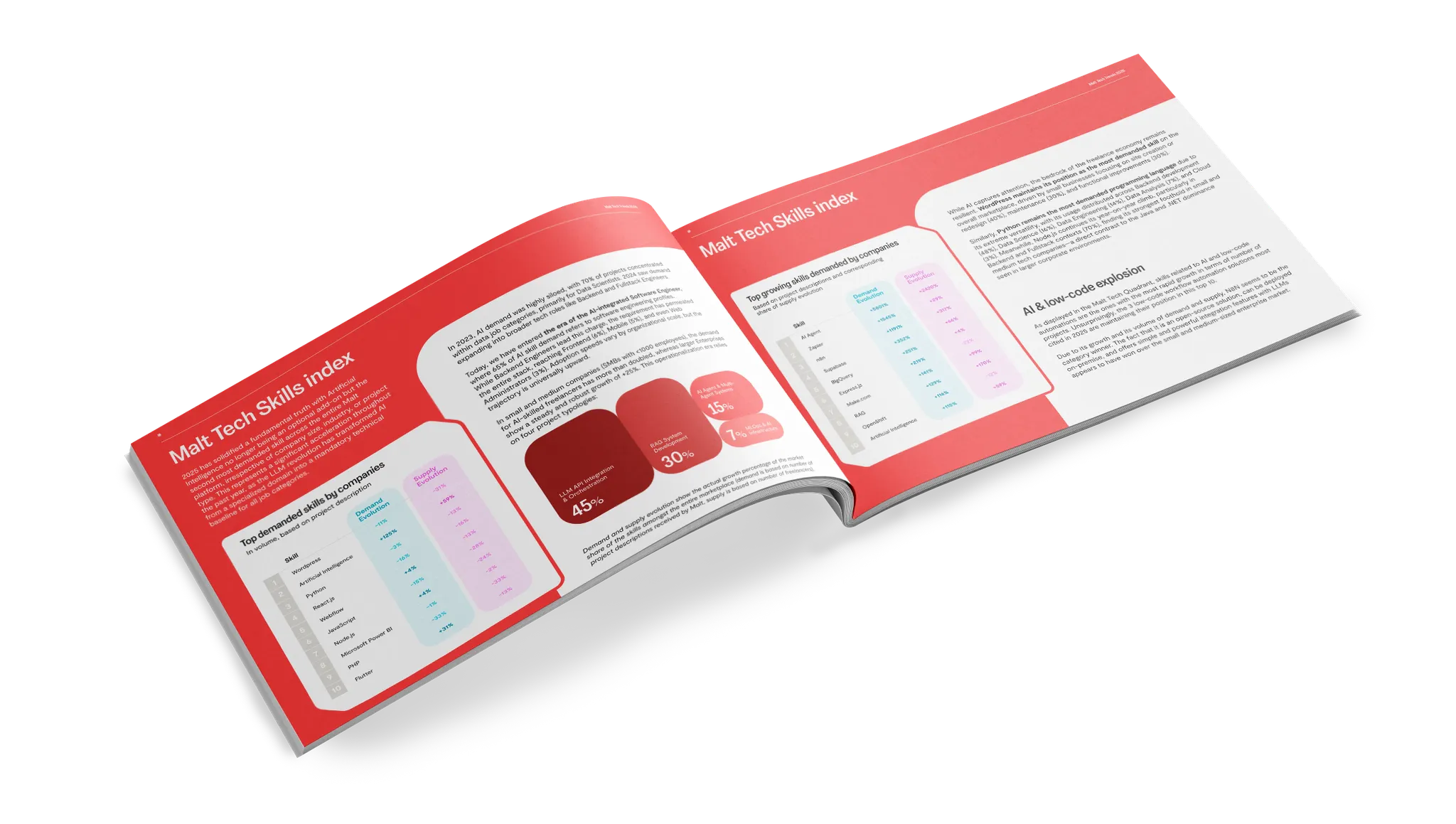
In 2025, we witnessed a tectonic shift in the very structure of our freelance tech community. The share of profiles highlighting historically dominant programming languages like JavaScript, Python, and Java declined by 20% to 30% in a single year. For example, while 40% of new registrants highlighted JavaScript in 2024, that figure dropped below 20% in 2025. Furthermore, Java and PHP saw their demand market shares drop by 32% and 33%, respectively.
This is not a decline in talent, but a clear redistribution of expertise. The "Builder Mindset" identified in previous years has evolved into an "Orchestrator Mindset". Today, a professional's value lies not just in writing raw code, but in directing intelligent systems.
As AI handles more of the foundational coding and routine technical tasks, the human workforce is moving up the value chain. We are seeing a collapse of the traditional silos between data and engineering. AI skills were once the exclusive domain of data scientists, but today, 65% of AI skill demand refers to software engineering profiles. Backend developers have effectively overtaken data scientists in the transition to becoming AI engineers.
The 2026 talent roadmap: 5 critical roles your organization must fill to stay competitive
As tech stacks decouple and AI integrates into every layer of software, new disciplines are rapidly emerging. To master this skill shift, companies are increasingly relying on specialized experts to design and maintain their systems.
The top five evolving and newly created job categories dominating this space include:
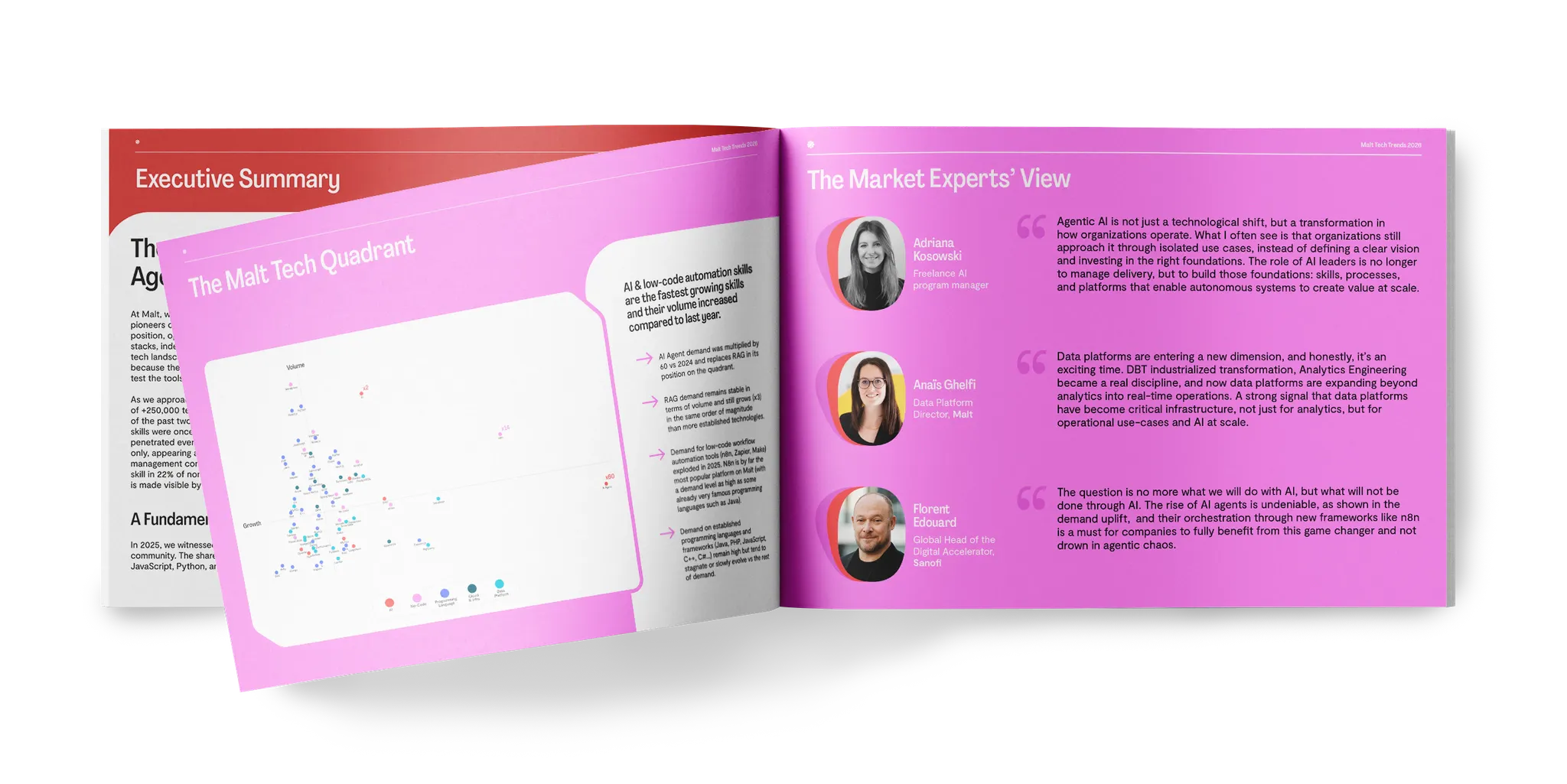
AI Strategy Consultant: Organizations can no longer approach AI through isolated use cases. They need a clear vision and strategic foundation. AI Strategy Consultants define these roadmaps. As Adriana Kosowski, AI Program Manager, notes: "The role of AI leaders is no longer to manage delivery, but to build those foundations: skills, processes, and platforms that enable autonomous systems to create value at scale".
Machine Learning Engineer: While generative AI captures the headlines, traditional ML remains absolutely critical. Traditional ML frameworks are still foundational, and Machine Learning Engineers bring the rigorous evaluation methodologies, deep learning expertise, and data science capabilities required for enterprise-grade deployment.
AI Engineer: This is a core hybrid role combining AI expertise with operational deployment capabilities. The AI Engineer freelancer community grew by a massive 229% over the past year. These professionals are moving beyond simple prototypes; they are deploying autonomous AI Agents capable of active workflow execution.
MLOps Engineer: Industrialization requires rigor. MLOps mentions in project briefs exploded by 178% year-over-year. However, MLOps freelancer supply only grew by 63%, creating a severe 1.7x demand-supply differential. There is a massive talent shortage for professionals who have the Kubernetes, Docker, and AWS expertise required to architect, monitor, and maintain GenAI applications in production.
Analytics Engineer: This role, which barely existed a few years ago, exploded by 103% in supply. Analytics Engineers own the transformation layer, applying software engineering practices directly to data. This surge is largely driven by the industrialization of data transformation around tools like dbt, which is now required in 33% of all data warehouse projects.
The judgment pipeline: securing human oversight for your automated systems
It is tempting to look at the rise of automation and agentic systems and assume human involvement will shrink. The reality in 2026 is exactly the opposite.
As Jehanne Dussert, a Tech Lead GenAI - AI Governance Lead, observes: "AI governance is still stuck in the declaratory phase: frameworks, policies, checklists. The next frontier is operationalization: continuous monitoring, real-time observability, measurable compliance in production. Until organizations bridge that gap, governance remains a promise, not a practice."
Choreographing intelligence
In 2026, a company's competitive advantage is no longer defined by the size of its engineering team or the maturity of its tech stack. Instead, the new moat is "Intelligence Liquidity", the ability to flow the right AI automation and human expertise into a problem at the precise moment it is needed.
The leaders who succeed in this Operationalization Era will be those who move beyond rigid, siloed teams built for execution. Instead, they will compose evolutionary systems that seamlessly integrate external expertise and autonomous AI. In this new era, we are no longer just managing code or roadmaps. We are choreographing intelligence.